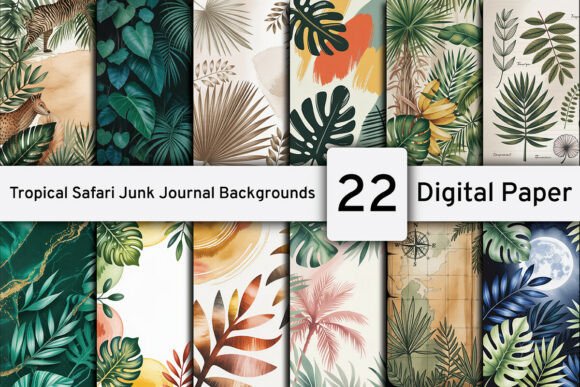
Unleash Your Creativity: 22 Tropical Safari Junk Journal Backgrounds
Every designer and crafter knows the struggle of finding the perfect canvas. You have a brilliant concept for a brand identity or a scrapbook layout, but the digital assets available feel generic or low-quality. That is where a curated set of backgrounds changes the game. The Tropical Safari Junk Journal Backgrounds collection offers a specific solution for creators who need high-impact visuals without the hassle of licensing issues or pixelated files. This set is not just a random assortment of images; it is a toolkit designed to add texture, depth, and personality to a wide array of projects.
The Visual Appeal of the Wild
When we talk about "Tropical Safari" in the context of design assets, we are referring to a distinct aesthetic. It blends the lush, vibrant energy of the jungle with the gritty, layered texture of a junk journal. Imagine deep greens, earthy tones, and pops of exotic color—orchid pinks, sunset oranges, and animal prints. These Tropical Safari Junk Journal Backgrounds likely feature a mix of organic botanical illustrations, distressed paper textures, and perhaps subtle map elements or vintage typography overlays.
The personality of this collection is adventurous yet grounded. It avoids the sterile look of modern minimalism. Instead, it embraces a hand-crafted feel. For a brand identity project targeting a bohemian fashion line or an eco-friendly product, these backgrounds provide an instant sense of authenticity. The visual hierarchy in your design will naturally shift when using such textured backgrounds. Unlike a flat white background, these assets allow you to layer text and focal points within "pockets" of visual interest, guiding the viewer's eye through the composition organically.
Practical Applications for Modern Creators
The versatility of the Tropical Safari Junk Journal Backgrounds extends far beyond traditional journaling. In the realm of web design, a subtle background texture can break the monotony of a flat layout. However, readability is paramount. When using these backgrounds for social media graphics or website hero sections, you must ensure sufficient contrast. A common mistake is placing light text directly over a busy botanical pattern. Instead, use these backgrounds as a base layer, then apply a semi-transparent overlay or place your text within a solid container to maintain professionalism and legibility.
For packaging design, particularly in the cosmetics, wellness, or artisanal food sectors, these backgrounds can create a premium unboxing experience. The high resolution—3600x3600 pixels at 300 DPI—means you can scale these images for large prints and posters without losing integrity. Entrepreneurs can use them to design invitations for destination weddings or launch parties, creating an immediate emotional connection with the recipient. The "instant download" aspect is critical here; it allows for rapid prototyping. You can test how a specific texture interacts with your logo design in minutes, rather than waiting for a custom illustration.
Integrating Assets into Your Design Strategy
Choosing the right design assets is about more than just aesthetics; it is about workflow efficiency. When evaluating these Tropical Safari Junk Journal Backgrounds, consider how they fit into your existing library. Do you need a serif font to pair with them? Often, the organic, hand-drawn nature of junk journal textures pairs beautifully with elegant serif typefaces for contrast, or a handwritten font to lean into the artisanal vibe. Avoid using overly technical sans serif fonts unless they are part of a modern, high-contrast editorial layout.
From a commercial font and asset perspective, the value lies in the file format and size. JPGs are universally compatible, making these assets easy to drop into Adobe Photoshop, Illustrator, Canva, or Procreate. Whether you are a blogger looking to refresh your headers, a publisher designing a book cover, or a crafter assembling a physical album, the workflow remains seamless. The key to success with these backgrounds is treating them as a foundational element of your brand consistency. By using the same set of textures across your digital and print materials, you create a cohesive visual story that resonates with your audience and elevates the perceived value of your final product.